How to stop procrastinating: 7 small tricks backed by research
Procrastination isn't laziness, and it isn't bad time management. It's mostly about feelings: putting off a task makes you feel better right now, and your future self pays for it later. The good news is that small, kind tricks work better than willpower.

Why we procrastinate
Psychologists Fuschia Sirois and Timothy Pychyl describe procrastination as choosing short-term mood repair over long-term goals. When a task feels boring, scary or overwhelming, avoiding it gives quick relief. The relief doesn't last, and the stress lands on your future self.1
A big review of procrastination research by Piers Steel found the same pattern. People put off tasks most when the task feels unpleasant, when they doubt they can do it well, when they're easily pulled toward something more fun, and when the deadline feels far away.2
So the fix isn't to be tougher on yourself. It's to make starting feel smaller, easier and nicer.
1. Shrink the first step
"Write the report" is a cloud. "Open the doc and write one messy sentence" is a step. Big tasks feel unpleasant partly because they're vague. Pick the smallest action that counts as starting, and do only that. Starting usually leads to more.
2. Make an if-then plan
Decide when and where you'll start, in the form "When X happens, I will do Y." For example: "When I finish lunch, I'll sit at my desk and open my notes." A review of 94 studies by Peter Gollwitzer and Paschal Sheeran found that if-then plans like this gave a medium-to-large boost to actually reaching goals, compared with just intending to.3
3. Set a short timer
Committing to forever is hard. Committing to 25 minutes is easy. A timer gives the task a clear finish line, and a break to look forward to. That's the idea behind the Pomodoro Technique.
4. Work next to someone
Having someone else working nearby, even silently, makes it easier to start and keep going. It adds a little gentle accountability and makes the work feel less lonely. This is called body doubling.
5. Pair it with something you enjoy
Save a treat for only while you do the task: a favorite playlist while you clean, a podcast only on the walk to the gym, a fancy coffee only while you do your taxes. Researchers call this temptation bundling. In one study, people who could only listen to gripping audiobooks at the gym went to the gym more at first, although the effect faded over the weeks.4 It's a great way to get going, even if you'll need to refresh the treat now and then.
6. Forgive yourself
Beating yourself up feels responsible, but it makes the task feel even worse, which feeds the urge to avoid it. In a study of university students, those who forgave themselves for procrastinating before their first exam procrastinated less before the next one.5 Try saying: "I put it off. That's human. What's one small thing I can do now?"
7. Make distractions harder to reach
Put your phone in another room or in a drawer, close the extra tabs, and keep only what the task needs in front of you. You don't need to rely on willpower when the tempting thing isn't right there.
When it's more than procrastination
Everyone procrastinates sometimes. If putting things off is constant, causes real problems at school, work or home, or comes with feeling low, anxious or stuck most days, it's worth talking to a doctor or counselor. Procrastination can be linked to things like ADHD, anxiety or depression, and support can make a big difference.
Beat procrastination with cats
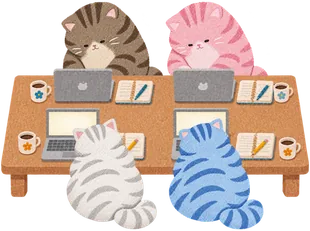
Focusland puts several of these tricks in one cozy app. You pick a room, sit down next to other cats, write the one task you're starting, and run a focus timer. Finishing a session earns coins and keeps your daily streak, and if you have to stop early, you can hold to give up with no guilt: your streak stays safe.
Common questions
Is procrastination a sign of laziness?
No. Research points to feelings, not laziness: people avoid tasks that feel unpleasant or uncertain to feel better in the moment.
What's the fastest way to stop procrastinating right now?
Pick the tiniest first step, set a timer for 10 to 25 minutes, and start. You're allowed to stop when the timer rings.
Does working with other people help?
For many people, yes. Working alongside someone, in person or online, makes it easier to start and stay on task.
Why do I procrastinate on things I actually want to do?
Even tasks you care about can feel big, uncertain or high-stakes. Caring a lot can make the fear of doing it badly stronger. Shrinking the first step and forgiving yourself both help here.
Sources
- Sirois, F., & Pychyl, T. (2013). Procrastination and the priority of short-term mood regulation: Consequences for future self. Social and Personality Psychology Compass, 7(2), 115–127. doi.org/10.1111/spc3.12011
- Steel, P. (2007). The nature of procrastination: A meta-analytic and theoretical review of quintessential self-regulatory failure. Psychological Bulletin, 133(1), 65–94. doi.org/10.1037/0033-2909.133.1.65
- Gollwitzer, P. M., & Sheeran, P. (2006). Implementation intentions and goal achievement: A meta-analysis of effects and processes. Advances in Experimental Social Psychology, 38, 69–119. doi.org/10.1016/S0065-2601(06)38002-1
- Milkman, K. L., Minson, J. A., & Volpp, K. G. M. (2014). Holding the Hunger Games hostage at the gym: An evaluation of temptation bundling. Management Science, 60(2), 283–299. doi.org/10.1287/mnsc.2013.1784
- Wohl, M. J. A., Pychyl, T. A., & Bennett, S. H. (2010). I forgive myself, now I can study: How self-forgiveness for procrastinating can reduce future procrastination. Personality and Individual Differences, 48(7), 803–808. doi.org/10.1016/j.paid.2010.01.029